
Deal sourcing is defined as the systematic process of identifying, evaluating, and securing real estate investment opportunities that match an investor’s criteria. Also called deal origination, it is the engine behind every successful acquisition strategy. Without a repeatable sourcing process, investors rely on luck instead of skill. The best real estate professionals treat deal sourcing as a pipeline discipline, not a one-time search. This guide breaks down the core strategies, operational systems, and channel nuances you need to build consistent deal flow in 2026.
What is deal sourcing in real estate investing?
Deal sourcing is the full process of finding properties before they reach or instead of reaching the open market. It covers every method an investor uses to generate leads, from broker calls to direct mail to driving neighborhoods. The industry term “deal origination” captures the same concept in commercial real estate circles, where institutional buyers formalize the process into structured workflows.
The stakes are high. A 2023 National Association of Realtors survey shows 15% of commercial sales were off-market. That figure means a significant slice of profitable inventory never appears on the MLS. Investors who rely only on listed properties compete for the same deals as everyone else, while off-market specialists access a less crowded pool.
Deal sourcing also separates professional investors from casual buyers. Professionals build systems. Casual buyers wait for listings. The difference in deal volume and pricing power is significant.

What are the main deal sourcing strategies real estate investors use?
The most productive investors run multiple channels at once. Consistent deal flow requires running 3 to 5 simultaneous sourcing channels. Relying on one method creates gaps when that channel dries up or gets crowded.
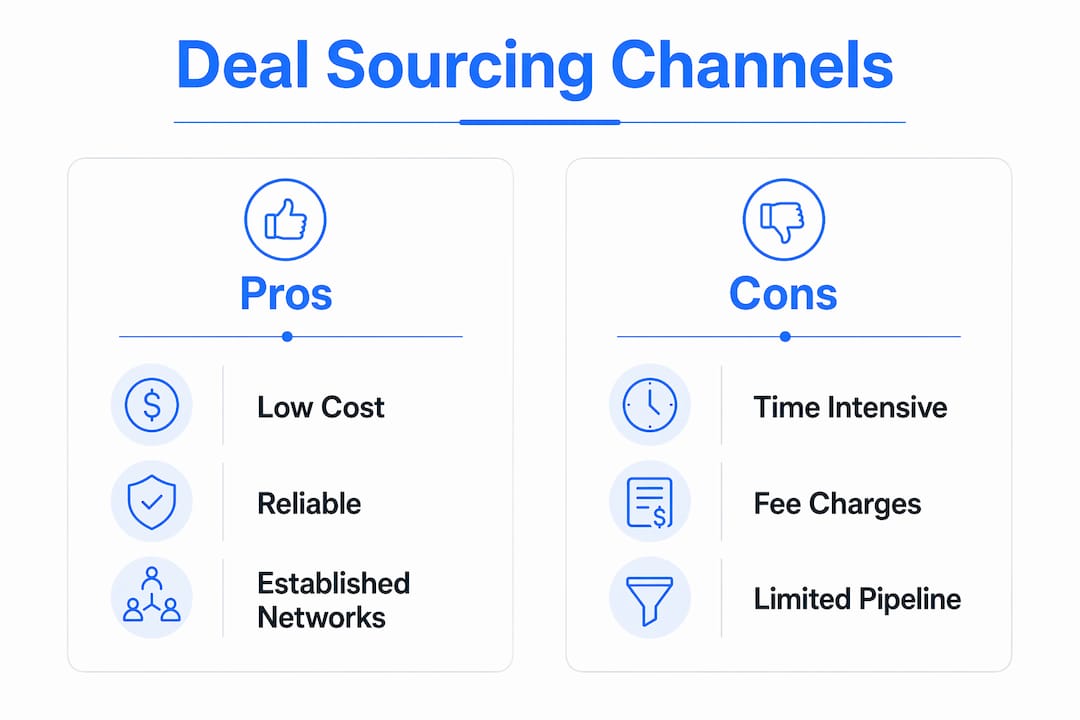
Broker relationships
Broker networks are cited by 73% of commercial real estate firms in 2024 as their most productive sourcing channel. Brokers bring pre-vetted deals and motivated sellers. Investors who respond quickly and communicate clearly get first access. The relationship is transactional but built on trust. Show up prepared, close what you say you will close, and brokers will call you first.
Direct outreach methods
Cold calling, direct mail, and digital marketing all fall under direct outreach. Cold calling distressed homeowners facing foreclosure, probate, divorce, or tax delinquency is one of the highest-conversion methods available. It reaches sellers before they list and before competitors know the property exists. Direct mail works the same angle but at scale, with lower response rates and higher volume. Digital marketing through Facebook and Google ads targets motivated sellers by search behavior and demographics.
Off-market sourcing techniques
- Driving for dollars: Physically canvassing neighborhoods to spot distressed properties. Labor-intensive but low cost. Follow-up of 4 to 6 contacts per lead is recommended for best conversion.
- Skip tracing: Identifying the true owner behind an LLC or holding company. Public records often list LLCs as owners, and skip tracing compresses research from hours to seconds.
- Probate and tax delinquent lists: Public records that identify motivated sellers before they reach the market.
Wholesaler partnerships
Wholesalers source deals and assign contracts to investors for a fee. Assignment fees typically range from $5,000 to $20,000 per deal. You pay for speed and convenience. The wholesaler has already done the outreach and negotiation. You get a deal ready to evaluate. The tradeoff is cost and reduced control over the sourcing process.
Pro Tip: Never rely on wholesalers as your only channel. Their inventory reflects their pipeline, not yours. Build direct outreach alongside wholesaler relationships to maintain deal flow independence.
How to build a repeatable deal sourcing pipeline
A pipeline is not a spreadsheet. It is an operational system that captures every lead, tracks its status, and triggers the next action automatically. Most investors lose deals not because they lack leads but because they lose track of them.
-
Build a unified intake system. Structured deal intake with uniform fields (address, source, status, next action) prevents blind spots from day one. Every lead from every channel enters the same system with the same data fields. This makes performance tracking possible.
-
Track source and cost per lead. Know which channel produced each deal and what it cost to get there. Without this data, you cannot allocate your budget or time effectively. A CRM built for real estate investing handles this automatically. CRM tools for wholesaling give you a single dashboard for all pipeline activity.
-
Set a follow-up cadence and stick to it. Contacting expired listings on the exact day the listing expires yields the highest conversion rates. FSBO sellers respond better after 2 to 3 weeks. Timing is not optional. It is a conversion variable.
-
Balance quality and quantity. A pipeline full of low-probability leads wastes time. Score leads by motivation level, property condition, and seller timeline. Prioritize the top tier and maintain the rest in a nurture sequence.
-
Automate where possible. Data automation tools handle follow-up reminders, lead status updates, and reporting. Deal flow results from both volume and the operational system that tracks opportunities from first contact to close. Manual tracking fails at scale.
Pro Tip: Set a weekly pipeline review. Thirty minutes every Monday to move leads forward, archive dead ones, and confirm your follow-up queue is loaded prevents deals from falling through the cracks.
What nuances distinguish effective deal sourcing channels?
Not every channel fits every investor. The right mix depends on your time, capital, and risk tolerance. Understanding the tradeoffs helps you build a sourcing strategy that matches your actual resources.
| Channel | Cost profile | Time required | Best for |
|---|---|---|---|
| Broker relationships | Low direct cost | High relationship time | Commercial and larger residential deals |
| Cold calling | Low to medium | High active time | Distressed sellers, off-market residential |
| Direct mail | Medium to high | Low active time | High-volume outreach at scale |
| Driving for dollars | Very low | Very high | Hyper-local distressed property identification |
| Wholesaler partnerships | High fees ($5,000–$20,000) | Very low | Investors prioritizing speed over cost |
| Skip tracing | Low | Low with tools | Identifying LLC-owned or hidden-ownership properties |
Driving for dollars has a low direct cost but demands significant time. Wholesalers deliver speed but charge fees that compress your margin. The optimal mix depends on whether your primary constraint is time or capital. An investor with more time than money should lean toward cold calling and driving for dollars. An investor with capital but limited bandwidth should engage wholesalers and invest in direct mail campaigns.
Timing also separates average investors from effective ones. Expired listings convert best on the day they expire. FSBO sellers need 2 to 3 weeks before they are receptive to investor offers. Calling too early or too late on either category wastes effort. Understanding seller psychology by lead type is a sourcing skill most investors never develop. For a deeper look at off-market property methods, the principles of timing and direct outreach apply across every channel.
Hidden fees also affect channel economics. Understanding real estate transaction costs helps investors calculate true cost per deal across channels, not just the upfront sourcing expense.
How to apply deal sourcing strategies effectively in 2026
The 2026 market rewards investors who move fast and come prepared. Sellers and wholesalers prioritize buyers who demonstrate credibility immediately. Here is how to position yourself to win more deals:
- Run 3 to 5 channels simultaneously. No single channel delivers consistent volume. Diversify across cold calling, direct mail, broker relationships, and at least one off-market method.
- Keep proof of funds ready. Investors who demonstrate proof of funds and respond quickly are prioritized by sellers and wholesalers. Have your documentation current and accessible at all times.
- Use skip tracing to reach decision-makers. When a property is owned by an LLC, skip tracing identifies the individual behind the entity. This shortens research time and opens direct conversations with the actual decision-maker.
- Align your channels with your constraints. Assess whether time or capital is your binding resource. Build your sourcing mix around that reality, not around what other investors do.
- Monitor off-market signals. Probate filings, tax delinquency lists, code violations, and pre-foreclosure notices all surface motivated sellers before they list. Set up regular pulls from public records in your target markets.
- Practice your outreach before you dial. Cold calling distressed homeowners requires skill. A poorly handled call loses a deal that took weeks to source. Preparation is not optional. Your real estate prospecting process should include rehearsed responses to common objections before you ever pick up the phone.
The investors who win in 2026 treat sourcing as a profession, not a side task. They track every metric, refine every channel, and show up to every conversation prepared to close.
Key takeaways
Effective deal sourcing is a repeatable pipeline process that combines multiple channels, disciplined follow-up, and operational systems to generate consistent investment opportunities.
| Point | Details |
|---|---|
| Multi-channel sourcing | Run 3 to 5 channels simultaneously to avoid gaps and reduce competition for any single source. |
| Off-market advantage | A significant share of commercial deals close off-market, making direct outreach a critical skill. |
| Pipeline systems matter | Unified intake with standard fields prevents lost leads and enables accurate cost-per-deal tracking. |
| Timing drives conversion | Contact expired listings the day they expire; wait 2 to 3 weeks before approaching FSBO sellers. |
| Credibility wins deals | Proof of funds and fast response time are the two fastest ways to get prioritized by sellers and wholesalers. |
What I’ve learned after years of watching investors source deals
Most investors treat deal sourcing like fishing. They cast a line, wait, and hope something bites. The investors who consistently close treat it like manufacturing. They build a system, feed it inputs, and expect predictable outputs.
The single biggest mistake I see is single-channel reliance. An investor finds success with direct mail, doubles down on it, and then watches their pipeline collapse when response rates drop or postage costs spike. Diversification is not just a financial principle. It applies directly to how you find deals.
The second mistake is poor follow-up discipline. A lead that does not convert on the first call is not a dead lead. It is a future deal waiting for the right timing. Investors who track every contact and follow up systematically close deals that their competitors abandoned after one attempt.
The third mistake is showing up unprepared. You can source the perfect lead and lose the deal in the first 60 seconds of a call because you stumbled through your pitch or could not handle a basic objection. Sourcing and conversion are two halves of the same process. Neglect either one and your results suffer.
My practical advice: build your pipeline system before you need it. Set up your CRM, define your intake fields, and establish your follow-up cadence on day one. Then practice your calls until your delivery is automatic. The deals are out there. The question is whether your operation is ready to capture them.
— Dave
ClosersLeague and the cold calling edge in deal sourcing
Cold calling remains one of the highest-conversion direct outreach methods for real estate investors. The challenge is that most investors practice on real sellers, which costs them deals they could have won with better preparation.
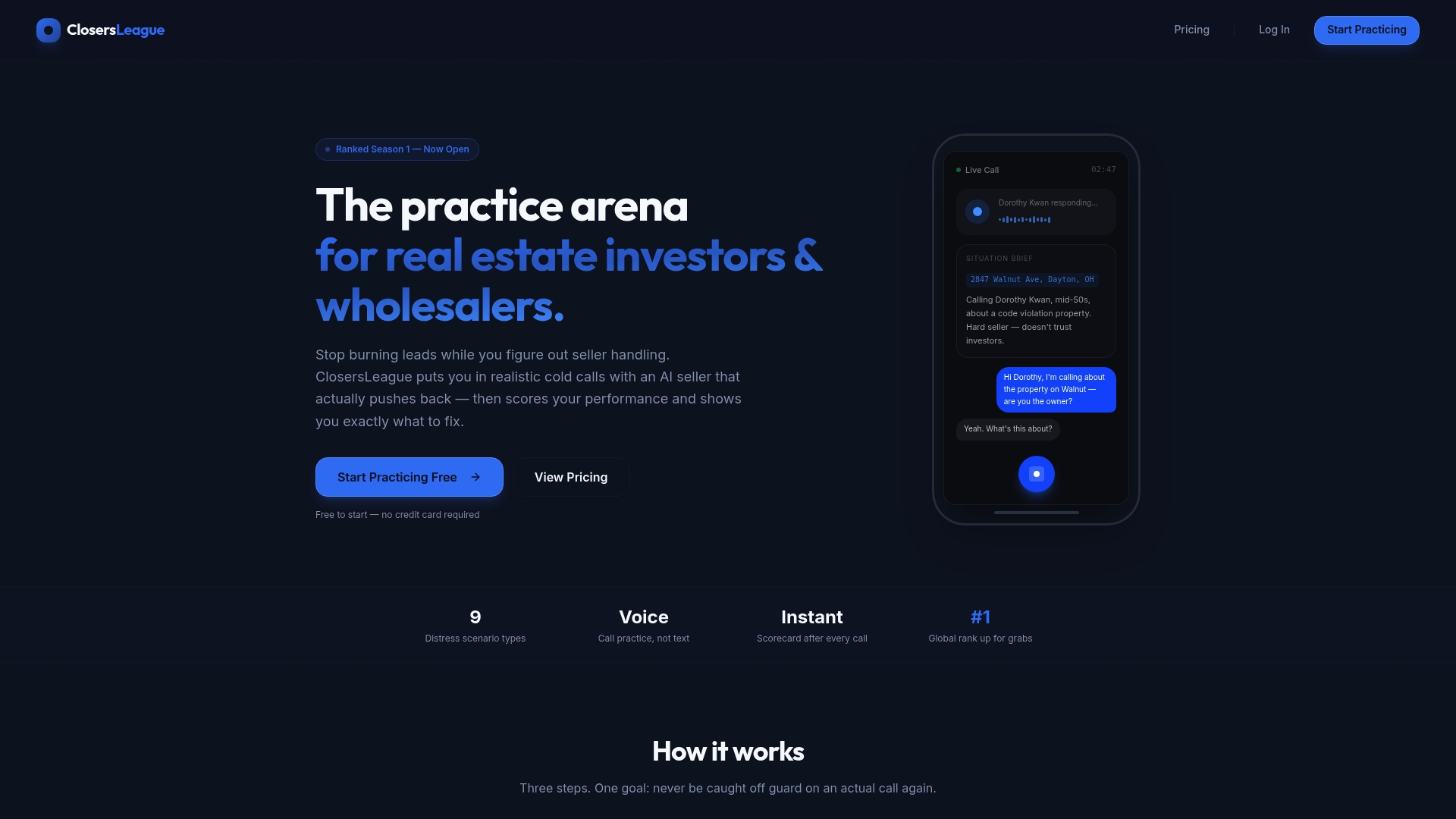
ClosersLeague is an AI-powered cold calling training platform built specifically for real estate investors and wholesalers. You practice calls on distressed seller scenarios, including inherited property, foreclosure, probate, and code violations, before you ever dial a real lead. The AI scores your performance, flags weak spots, and lets you drill the same scenario until your delivery is sharp. If cold calling is part of your sourcing strategy, inherited property cold calling practice gives you a realistic environment to build the confidence and skill that convert sourced leads into closed deals.
FAQ
What is deal sourcing in real estate?
Deal sourcing is the systematic process of identifying and securing real estate investment opportunities, often before they reach the open market. It includes methods like cold calling, broker relationships, direct mail, and off-market outreach.
What is deal origination?
Deal origination is the industry term for deal sourcing, commonly used in commercial real estate. It refers to the full process of finding, evaluating, and initiating contact with potential investment opportunities.
Why is deal sourcing important for investors?
Deal sourcing creates consistent deal flow, which is the foundation of a profitable investment operation. Without a repeatable sourcing process, investors compete for the same listed properties and pay market prices with no edge.
How many deal sourcing channels should I run at once?
Running 3 to 5 simultaneous sourcing channels produces the most consistent results. Relying on a single channel creates gaps when that method underperforms or faces increased competition.
What is the fastest deal sourcing method?
Wholesaler partnerships deliver the fastest access to deals, but assignment fees of $5,000 to $20,000 per deal compress your margin. Cold calling and broker relationships offer better economics for investors willing to invest the time.